The team led by Prof. LI Wenwei from Suzhou Institute for Advanced Research, University of Science and Technology of China made a breakthrough in the anaerobic self-assembly of bacterial-quantum dots hybrid and photocatalytic hydrogen production. This work titled Anaerobic self-assembly of regenerable bacteria-quantum dots hybrid for solar hydrogen production was published in Nanoscale (DOI: 10.1039/D2NR01777F) recently.
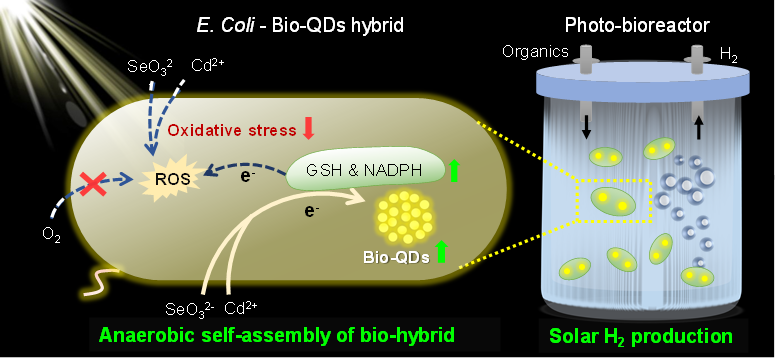
Inorganic-biological hybrid systems (bio-hybrid), comprising fermentative bacteria and inorganic semiconductor photosensitizers for synergistic utilization of solar energy and organic wastes, offer opportunities for sustainable fuel biosynthesis, but the low quantum efficiency, photosensitizer biotoxicity and inability for self-regeneration are remaining hurdles to overcome. Prof. LI's team unveiled a previously-overlooked role of oxygen in suppressing the biosynthesis of cadmium selenide quantum dots (CdSe QDs) and the metabolic activities of Escherichia coli, and accordingly adopted a simple oxygen-regulation strategy to enable self-assembly of bacterial-QDs hybrid for efficient solar hydrogen production. Shifting from aerobic to anaerobic biosynthesis significantly lowered the intracellular reactive oxygen species level and raised the NADPH and thiol-protein production, enabling two-order-of-magnitude higher bio-QDs synthesis rate and yielding CdSe-rich products. The bacteria with abundant biocompatible intracellular bio-QDs naturally formed high-activity, self-regenerable bio-hybrid and achieved quantum efficiency of 28.7% for visible-light-driven photocatalytic hydrogen production, outperforming all the existing bio-hybrids. It also exhibited high stability during cyclic operation and robust performance for treating real wastewater under simulated sunlight. The study provides valuable new insights into the metallic nanomaterial biosynthesis process to guide the design of self-assembled bio-hybrid towards sustainable energy and environmental applications.
The first author is PhD student WANG Xuemeng, and the corresponding author is Prof. LI Wenwei. The study is funded by the National Natural Science Foundation of China.
Paper link: https://pubs.rsc.org/en/content/articlelanding/2022/nr/d2nr01777f/unauth
New Advances in Construction of Bio-Hybrid for Solar Hydrogen Production
Publish Date:2022-05-10
Views:828

